An advertised staking APY looks like a fixed number, but it’s actually the output of several moving parts — network issuance, participation rate, validator commission, and price volatility in the underlying token. Understanding where that number comes from is what lets you tell a genuinely attractive offer from one that’s just newer or riskier than it looks.
{{IMAGE:assets/images/apy-featured.webp}}
Where staking rewards come from
On most proof-of-stake networks, staking rewards are funded from two sources: newly issued tokens (protocol-level inflation paid to validators for securing the network) and a share of transaction fees collected from the blocks a validator produces. The exact mix differs by network — some rely almost entirely on issuance, others give transaction fees a larger role, especially during periods of high network activity.
Why advertised APY isn’t guaranteed
Three things can make your realized return differ from the number you saw advertised:
- Network participation rate. On many networks, the per-validator reward rate is designed to fall as more of the total supply gets staked, and rise as less of it does — so the APY genuinely moves over time as more or fewer people stake.
- Validator commission. If you delegate rather than run your own validator, the validator takes a cut of the gross reward before passing the rest to you.
- Token price movement. APY is calculated in the token’s own units, not in a fiat currency. A 10% APY does not protect you from a 30% drop in the token’s dollar price over the same period — you’d have more tokens, worth less.
A worked (hypothetical) breakdown of where a reward comes from
To make the two funding sources concrete, here’s a purely illustrative hypothetical — not a claim about any real network’s current figures. Imagine a network where validators collectively earn a reward pool over a given period made up of newly issued tokens plus a share of transaction fees from the blocks they produced. If issuance contributed roughly three-quarters of that pool and transaction fees the remaining quarter, then a spike in network activity (more transactions, more fees) would push the effective reward rate up even if the issuance schedule itself didn’t change — and a quiet period with little transaction activity would pull it back down. This is why the same network’s real-world APY moves around over time even though its issuance schedule alone might look fixed on paper.
Validator commission and its effect on your real yield
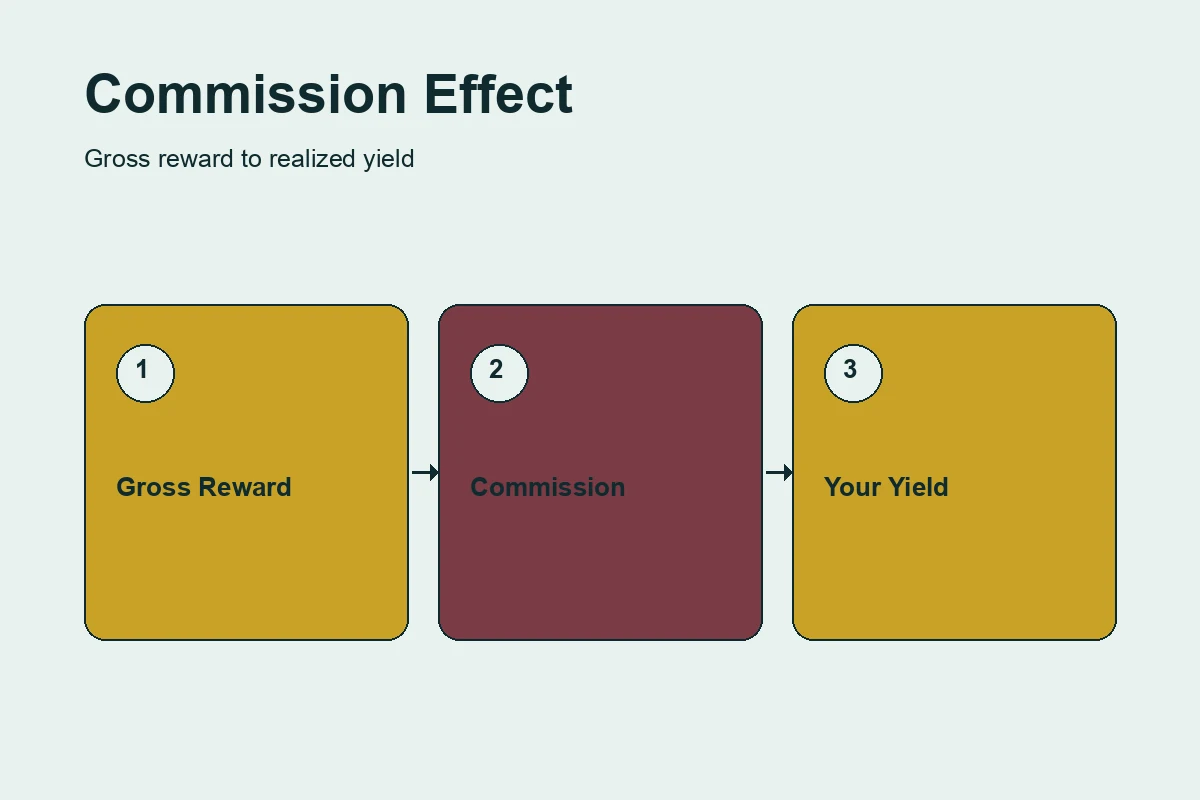
Here’s a hypothetical, illustrative example only — not a claim about any specific network’s current rate: if a network’s gross staking reward is 5% APY and the validator you delegate to charges a 10% commission on rewards, your realized yield is not 5% but roughly 4.5% (5% minus 10% of that 5%). Commission rates vary widely between validators on the same network, so two people staking the identical amount on the identical network can end up with meaningfully different realized returns purely based on which validator they chose.
{{IMAGE:assets/images/apy-commission-effect.webp}}
Compounding frequency matters more than it seems
Whether and how often rewards compound changes your realized return even at an identical headline rate. Some networks and platforms auto-compound rewards into your staked balance continuously or on a fixed schedule, so your rewards themselves start earning rewards; others pay out rewards to a separate, unstaked balance that you have to manually re-stake yourself if you want the same effect. Two offers advertising the same “5% APY” can produce different actual returns over a year depending on which of these they mean and how often compounding actually happens — it’s worth checking which figure a platform is quoting rather than assuming.
Why staking APY isn’t like a savings-account APY
It’s tempting to compare a staking APY directly to a bank savings rate, but the comparison breaks down in a few important ways. A bank deposit is typically denominated in, and insured in, a stable fiat currency up to some coverage limit. A staking reward is paid in the same volatile token you staked, with no equivalent deposit-insurance backstop — the yield is real, but it doesn’t protect the principal’s dollar value the way a savings account’s insured status protects its principal. Treating a double-digit staking APY as equivalent to a double-digit savings rate significantly understates the risk difference between the two.
Why APY varies network to network and changes over time
Because reward rates are a function of issuance schedule, participation rate, and fee activity — all of which differ by network and shift over time — there’s no single “normal” staking APY across crypto. A network offering a noticeably higher rate than comparable networks isn’t automatically a red flag, but it’s worth understanding why: it can reflect a genuinely different token-supply design, or it can reflect a newer network still in an early, higher-inflation phase. Always check the current rate at the point you’re actually staking rather than relying on a number you saw at some point in the past, since these figures are exactly the kind of volatile fact that goes stale quickly.
FAQ
Is APY the same as APR?
Not exactly — APY typically accounts for compounding (reinvesting rewards to earn rewards on rewards), while APR does not. Check which figure a platform is actually quoting, since the two can differ noticeably at higher rates.
Why do two exchanges advertise different APY for the same coin?
Usually because of different commission structures, different underlying validators, or promotional rates that don’t reflect the ongoing long-term rate.
Does a higher APY always mean a better deal?
No — realized yield after commission matters more than the headline number, and a significantly above-market rate is worth understanding before chasing it. See our staking safety overview for how reward rate fits into the broader risk picture.