Staking a proof-of-stake cryptocurrency is not automatically safe, and it is not automatically risky either — the honest answer depends on how you stake, which network you use, and how much lock-up illiquidity you’re willing to accept. Exchange staking, self-custody delegation, and liquid staking each carry a genuinely different risk profile, not just a different interface. Once you understand what you’re actually agreeing to, comparing highest apy crypto staking offers is a reasonable next step — but only after the risk side of the equation is clear, which is what this page walks through.
How staking actually works
Proof-of-stake networks replace mining with staking: instead of burning electricity to win the right to add the next block, validators lock up (“stake”) a balance of the network’s own token as collateral. In return for proposing and confirming blocks honestly, a validator earns rewards. If a validator breaks the network’s rules, it can lose part of that collateral. Everyday holders who don’t want to run a validator themselves can usually delegate their tokens to one, or stake through a custodian, and share in the rewards (minus a commission) without operating the infrastructure directly.
Bonded capital is doing real security work here, not just sitting as collateral for show: a proof-of-stake network needs some way to make dishonest validator behavior expensive, since unlike mining, proposing or signing a block costs a validator essentially nothing in electricity or hardware. Staked capital fills that gap — it’s the thing a validator actually stands to lose if it misbehaves, which is what gives the network’s consensus process real economic teeth.
Where staking actually happens
In practice you’ll meet staking in one of three places: a toggle inside an exchange account (custodial staking, no separate wallet interaction required), a “delegate” action inside a self-custody wallet pointed at a validator you choose, or a deposit into a liquid-staking protocol’s own interface that hands you back a derivative token. All three ultimately do the same underlying thing — lock your tokens toward a validator — but the interface you’re staking through is a direct signal of which custody model in the table below you’re actually agreeing to.
The real risks, by custody model
Most “is staking safe” answers treat this as one flat question. It isn’t — the risk depends heavily on who is actually holding your keys and running the validator on your behalf. The table below breaks down the three common models.
| Model | Who holds the keys | Main risk | Slashing exposure |
|---|---|---|---|
| Exchange (custodial) staking | The exchange | Platform insolvency, withdrawal suspension, or regulatory seizure | Usually absorbed by the platform, not passed directly to you |
| Self-custody / delegated staking | You | Poor validator selection; your own key management | Falls on you if your chosen validator misbehaves |
| Liquid staking | A staking protocol/smart contract | Smart-contract exploits and derivative-token de-pegging | Indirect, plus contract risk on top of it |
Each of these deserves more depth than a homepage table can give — see our full exchange vs. self-custody vs. liquid staking comparison for the complete picture, including which model tends to fit which risk tolerance.
Slashing, explained plainly
Slashing is a protocol-level penalty: if a validator provably misbehaves — most commonly by signing two conflicting blocks (“double-signing”) or going offline for an extended period — the network destroys part of that validator’s staked balance. It’s a punishment aimed at validators, not directly at delegators, but delegators can still lose a portion of their delegated stake if the validator they chose gets slashed. This is a documented mechanism across major proof-of-stake networks, not a hypothetical edge case. Kraken’s own staking-safety explainer walks through the mechanics in more technical detail. For the full breakdown of what specifically triggers it and how exposure differs by custody model, see what is slashing in crypto staking.
Lock-up and unbonding periods aren’t the same everywhere
“How long is my crypto locked up if I stake it?” doesn’t have one universal answer — unbonding windows vary by network and change over time as protocols upgrade. As of 2026, Cardano allows unstaking with no cooldown at all, Solana’s unstaking tracks its roughly two-to-three-day epoch cycle, and Ethereum’s validator exit queue is dynamic — it has swung between a multi-day backlog and near-zero wait within the same year, depending on how many validators are exiting the network at once, per Figment’s staking-timeline research. Networks like Polkadot have historically used a much longer unbonding window, and are actively shortening it through governance changes. The practical takeaway: check the current unbonding period for your specific network before you stake, don’t assume it matches what you read about a different chain, and don’t stake funds you might need on short notice.
How to reduce your risk
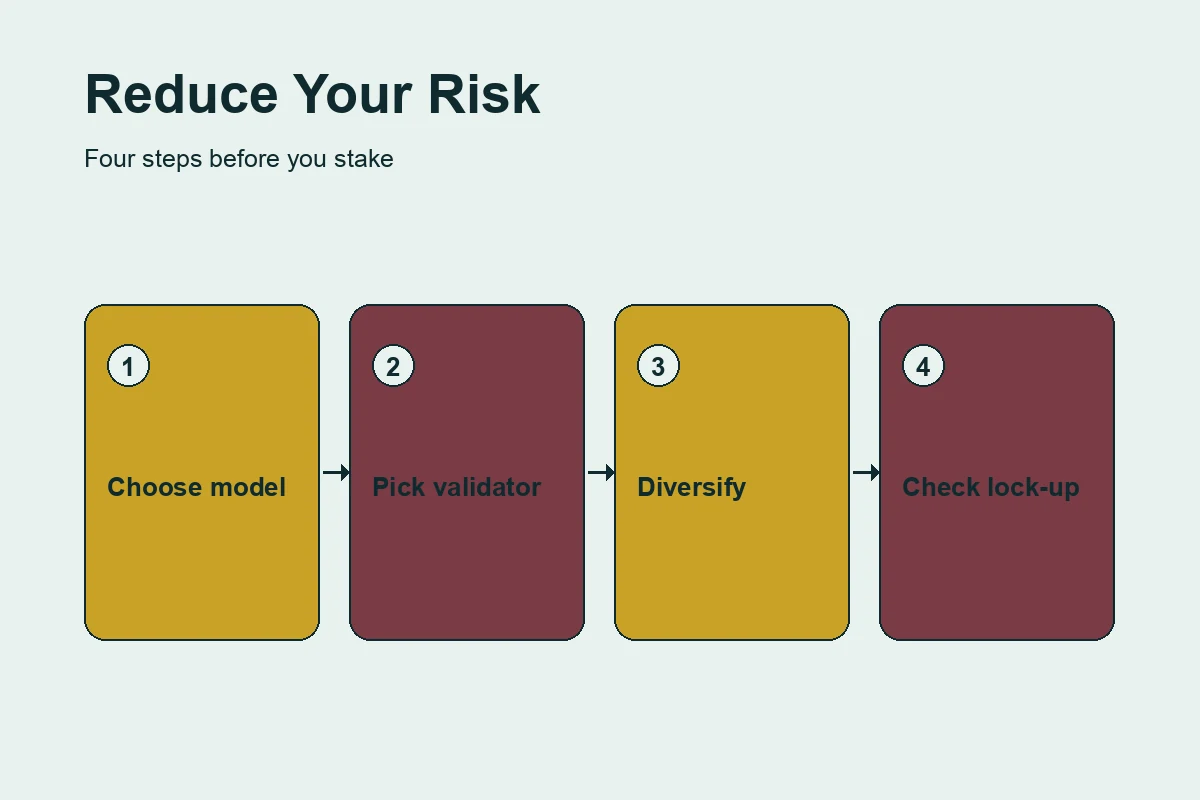
- Match the custody model to your comfort level. If you’re not prepared to manage your own keys and pick a validator, custodial staking removes that burden at the cost of counterparty risk. If counterparty risk worries you more, self-custody removes it at the cost of taking on validator-selection risk yourself.
- Choose validators with a documented uptime track record if you’re self-custody staking — downtime and double-signing are the two most common slashing triggers, and a validator’s history is usually public.
- Diversify across more than one validator where the network supports it, so a single validator’s failure doesn’t affect your entire stake.
- Read the unbonding period before you commit, not after you want your funds back — and only stake an amount you can afford to have locked for that window.
- Remember that yield doesn’t offset price risk. A double-digit staking APY does not protect you from a much larger drop in the underlying token’s price.
Once you’ve weighed these factors and decided which custody model fits your situation, the next practical question is how the reward rate itself is actually calculated — see how staking rewards and APY are calculated before comparing offers.
What to actually check before choosing a validator or platform
“Choose a reputable validator” is easy advice to give and hard to act on without knowing what to actually look at. These are the concrete signals worth checking:
- Uptime history, not just current status. A validator’s public block explorer record shows whether it’s had downtime penalties in the past, not only whether it’s online right now.
- How long it’s been operating. A longer track record with a clean slashing history is a stronger signal than a brand-new validator with no history either way.
- Commission stability. Frequent commission-rate changes can signal an operator testing what the market will bear rather than running a predictable service.
- For custodial platforms: how they talk about risk. A platform that frames staking as risk-free, or buries the unbonding period, is a worse sign than one that states its terms plainly.
- For liquid staking: whether the protocol has been independently audited, and how the derivative token has actually tracked the underlying asset’s value during past periods of market stress.
FAQ
Can I lose my entire staked balance?
Total loss from slashing alone is uncommon — slashing penalties are typically proportional to the severity of the violation, not an automatic wipeout. Your bigger practical risk is usually price volatility in the underlying token, or, for custodial staking, the platform itself becoming insolvent.
Is staking on an exchange safer than staking myself?
Neither is categorically safer — they trade one risk for another. Exchange staking removes validator-selection and slashing responsibility from you but adds platform/counterparty risk. Self-custody removes counterparty risk but makes you responsible for validator choice and key security.
Do I need to actively manage anything once I start staking?
With custodial staking, generally no. With self-custody delegation, you should periodically check that your chosen validator still has strong uptime, since validator performance can change over time.
What happens to my rewards during the unbonding period?
Once you initiate unstaking, most networks stop paying rewards on that balance immediately even though the funds remain locked until the unbonding window finishes.
Is a higher advertised APY always a sign of higher risk?
Not necessarily by itself, but a much higher rate than comparable networks is worth investigating — it can reflect genuinely different tokenomics, or it can reflect a newer, less battle-tested network. See how staking APY is calculated for what actually drives the number.
Can I switch validators or custody models after I’ve started staking?
Generally yes, but each switch is subject to the network’s unbonding period before the funds are free to move again, so switching isn’t instant — factor that delay in before deciding to move.
Does staking require any technical skill?
Custodial staking generally doesn’t — it’s usually a toggle in an exchange account. Self-custody delegation requires comfort managing a wallet and picking a validator, but not running validator infrastructure yourself, since delegation doesn’t require operating a node.