Once you’ve accepted that staking carries some risk, the next real decision isn’t whether to stake — it’s which of three fundamentally different custody models to use: staking through an exchange, delegating from your own self-custody wallet, or using a liquid staking protocol. Each shifts the risk around differently rather than simply offering “more” or “less” of it.
{{IMAGE:assets/images/custody-featured.webp}}
The three models in one table
| Criteria | Exchange (custodial) | Self-custody / delegated | Liquid staking |
|---|---|---|---|
| Who holds the private keys | The exchange | You | A staking protocol / smart contract |
| Counterparty risk | Yes — platform insolvency, withdrawal freezes | None from a third party | Yes — the protocol and its smart contracts |
| Slashing exposure | Usually absorbed by the platform | Passed through to you if your validator is slashed | Passed through to holders of the derivative token, indirectly |
| Liquidity while staked | Depends on the platform’s own terms | Locked for the network’s unbonding period | Often tradeable immediately via the derivative token, though the token can de-peg from the underlying asset |
| Effort required | Minimal — the platform handles validator operations | You choose and monitor a validator | Minimal, but requires trusting the protocol’s smart contracts |
{{IMAGE:assets/images/custody-table-visual.webp}}
Exchange (custodial) staking
You deposit tokens with an exchange, and the exchange runs (or delegates to) validators on your behalf, crediting you rewards minus a commission. This is the lowest-effort option and typically absorbs slashing risk on your behalf, but it reintroduces the exact counterparty risk self-custody crypto is usually meant to avoid: if the exchange becomes insolvent, suspends withdrawals, or faces regulatory action, your staked balance can become inaccessible — a risk that recent centralized-platform failures have made concrete rather than theoretical.
Self-custody / delegated staking
Your private keys never leave your own wallet; you delegate your stake to a validator you choose, and the validator processes blocks without ever taking custody of your funds. This removes exchange counterparty risk entirely, but it transfers responsibility back to you: you have to evaluate and monitor validator quality yourself, and a mistake by your chosen validator (see what is slashing in crypto staking) is passed through to your delegated balance.
Liquid staking
Liquid staking protocols let you stake while receiving a tradeable derivative token representing your staked position, so you can use that token elsewhere (as collateral, for example) instead of having your capital fully locked. This solves the illiquidity problem of the other two models, but adds a new one: you’re now trusting the protocol’s smart contracts not to be exploited, and trusting that the derivative token reliably tracks the value of the underlying staked asset. If either of those assumptions breaks, the derivative token can trade below the value of what it’s supposed to represent.
What happens when things go wrong, model by model
Comparing criteria in the abstract only goes so far — here’s what an actual failure looks like under each model.
Exchange staking: if the platform becomes insolvent or is ordered by a regulator to freeze withdrawals, your staked balance (and any unstaked balance held on the same platform) can become inaccessible for an extended period, or in a worst case, be subject to creditor claims in an insolvency proceeding — the same category of risk as holding any other asset on a centralized platform, staking or not.
Self-custody staking: if your chosen validator double-signs, you lose a proportional share of your delegated balance to slashing, but your ability to withdraw and re-delegate to a different validator afterward is unaffected by anything the exchange model would expose you to — there’s no platform standing between you and your funds to freeze anything.
Liquid staking: if the protocol’s smart contract is exploited, or if a large wave of holders tries to exit the derivative token at once, the token can trade at a discount to the underlying staked asset it’s supposed to represent — meaning you could sell for less than your actual staked position is worth, even though the underlying stake itself wasn’t directly slashed.
Which model fits which risk tolerance
- Want the least hands-on involvement and are comfortable with platform risk: exchange staking.
- Want to eliminate counterparty risk and are willing to evaluate a validator yourself: self-custody delegation.
- Want liquidity while staked and are comfortable evaluating smart-contract risk: liquid staking.
None of these is a strictly “safer” default — each one trades a specific risk for a specific convenience. For how the reward side of this decision works once you’ve picked a model, see how staking rewards and APY are calculated.
Switching between models
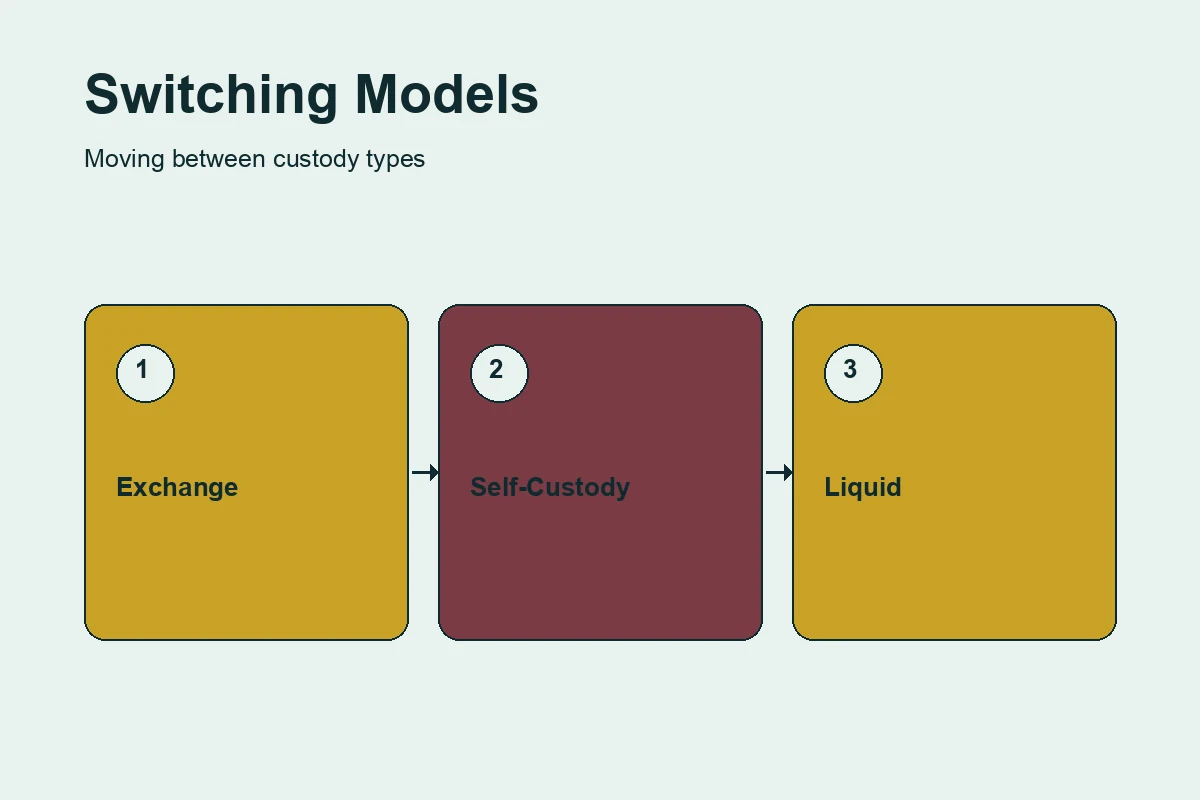
Moving from one model to another isn’t instant, and the friction differs by direction:
- Exchange → self-custody: unstake on the exchange (subject to its own withdrawal terms), withdraw the tokens to your own wallet, then delegate to a validator yourself — two separate waiting periods can stack if the exchange has its own queue on top of the network’s unbonding period.
- Self-custody → liquid staking: unstake from your validator, wait out the network’s unbonding period, then deposit into a liquid staking protocol — or, on some networks, certain liquid staking providers let you migrate a delegation directly without a full unbonding cycle.
- Liquid staking → exchange or self-custody: redeem or sell the derivative token, which is often the fastest of these transitions since it doesn’t require waiting on the underlying network’s unbonding period at all — that’s the specific liquidity trade-off liquid staking is designed to offer.
{{IMAGE:assets/images/custody-switching-process.webp}}
FAQ
Is liquid staking riskier than regular self-custody staking?
It carries a different risk, not necessarily a larger one — you trade illiquidity for smart-contract and de-pegging risk. Which is “riskier” depends on how much you trust the specific protocol’s contract security versus how much the lock-up period itself bothers you.
Can I switch between these models later?
Generally yes, though moving out of one model (especially unstaking from self-custody or exchange staking) is subject to that network’s unbonding period, so switching isn’t instant.
Do all three models pay similar rewards?
Not necessarily — commission structures and, for liquid staking, protocol fees differ, which affects your realized yield even when the underlying network reward rate is the same. See how staking APY is calculated.