Slashing is a protocol-level penalty on proof-of-stake networks: if a validator provably breaks the network’s consensus rules, the protocol automatically destroys part of that validator’s staked balance. It exists to make dishonest or careless validator behavior economically costly, and it’s a documented, load-bearing part of how proof-of-stake security works — not a rare edge case. If you delegate your tokens to a validator or stake through a self-custody setup, understanding what triggers it changes how you choose a validator in the first place.
{{IMAGE:assets/images/slashing-featured.webp}}
What triggers slashing
The exact rules differ slightly by network, but slashing conditions generally fall into two categories:
- Double-signing (equivocation). A validator signs two conflicting blocks or votes for the same slot. This is treated as the most serious offense because it directly threatens the network’s ability to agree on a single chain history, and it’s usually the most heavily penalized violation.
- Extended downtime / inactivity. A validator that goes offline and fails to participate in consensus for a sustained period is penalized, though typically far less severely than double-signing — some networks distinguish this as a separate, lighter “inactivity leak” rather than a full slash.
Double-signing is almost always accidental on the validator operator’s side — commonly caused by running duplicate validator software instances (a misconfiguration, not malice) — but the protocol can’t distinguish intent from a network-security standpoint, so the penalty applies regardless.
How much you can actually lose
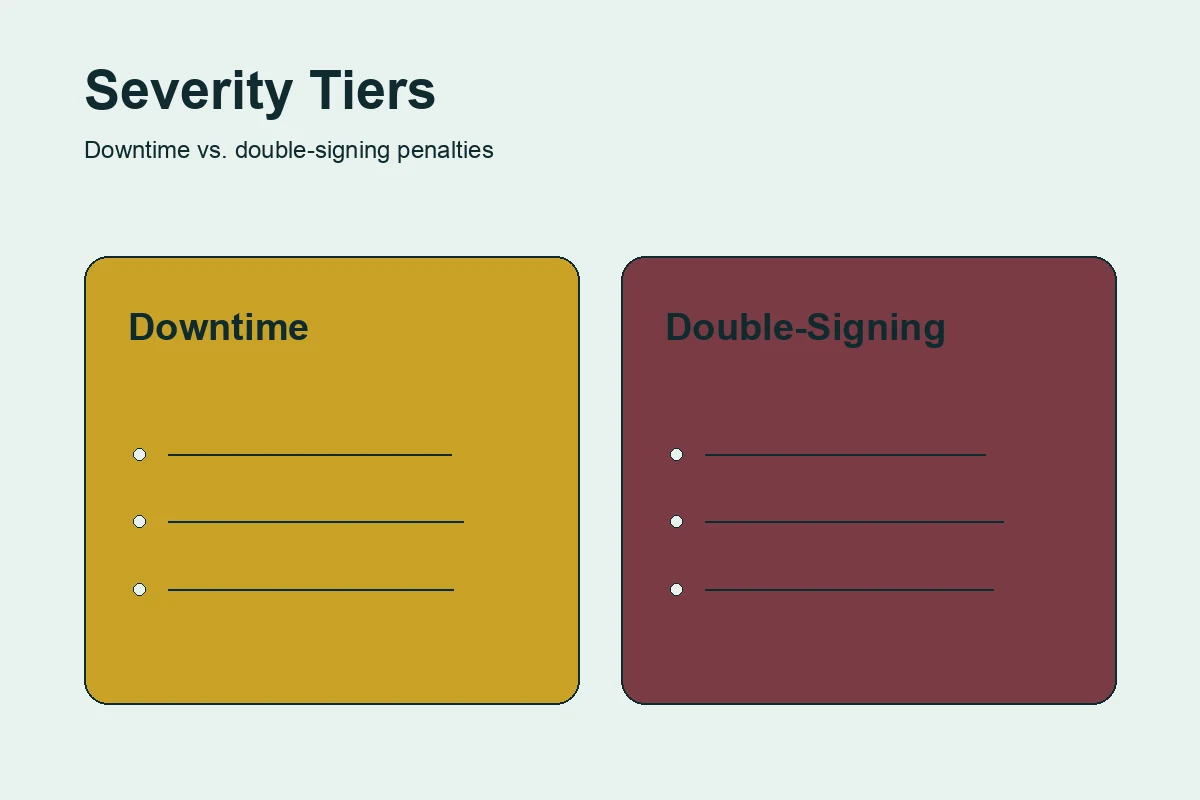
Slashing penalties are proportional, not all-or-nothing, and the exact percentage varies by network and by how many other validators are being slashed around the same time (some protocols scale the penalty up if it looks like a coordinated attack rather than an isolated mistake). As a general shape, not a fixed number:
| Violation type | Typical severity | Who is affected |
|---|---|---|
| Extended downtime / inactivity | Small, gradual penalty over time | Primarily the validator; delegators see a minor reduction in rewards |
| Double-signing (isolated) | A meaningful one-time penalty | The validator and, proportionally, anyone delegating to it |
| Double-signing (coordinated/mass event) | Substantially larger penalty | The validator and its delegators, scaled to the severity of the event |
{{IMAGE:assets/images/slashing-severity.webp}}
Because these figures move as protocols upgrade their penalty parameters, treat any specific percentage you see quoted elsewhere as a snapshot in time, not a permanent constant — check the current parameters for the specific network before relying on a number.
Who bears the risk (you vs. an exchange)
This is where custody model matters more than most people expect. If you stake through an exchange, the exchange runs the validator infrastructure and, in most cases, absorbs slashing risk itself rather than passing a validator’s mistake directly through to your balance — it’s effectively priced into the commission they charge. If you delegate your own tokens directly to a validator you chose, a slashing event on that validator is passed through to you proportionally. See our full exchange vs. self-custody vs. liquid staking comparison for how this plays out across all three models, including liquid staking’s additional smart-contract layer.
Why slashing exists in the first place
Proof-of-stake networks need a way to make dishonest behavior expensive, because unlike proof-of-work (where attacking the network costs real electricity and hardware), staking collateral is the network’s main defense against a specific failure mode researchers call “nothing-at-stake” — the risk that a validator could vote for multiple conflicting versions of the chain at effectively no cost, since signing a vote doesn’t burn any resources the way mining does. Slashing closes that gap by attaching a real financial cost to conflicting votes, which is why double-signing specifically is treated as the most serious violation rather than an equally-weighted rule among several.
How to check a validator’s slashing history before delegating
If you’re self-custody staking, this is the single most useful diligence step before choosing who to delegate to:
- Look up the validator on the network’s public block explorer — slashing events are recorded on-chain and are not something a validator operator can hide or delete.
- Check the validator’s historical uptime percentage, not just its current status — a validator that’s currently online may still have a history of downtime penalties.
- Check how long the validator has been operating. A longer track record with zero or minimal slashing events is a stronger signal than a new validator with no history either way.
- If the network’s explorer shows commission-rate history, check whether the validator has changed its commission recently — frequent changes can be a sign of an operator testing what the market will bear rather than running a stable, predictable service.
How to reduce slashing exposure
- Prefer validators with a long, publicly visible uptime track record over new or unproven ones.
- Avoid validators that appear to run on unreliable or unclear infrastructure — downtime penalties are the easiest slashing trigger to avoid simply by picking a well-operated validator.
- Where the network supports it, split your stake across more than one validator so a single operator’s mistake doesn’t affect your full balance.
- If you’d rather not evaluate validators yourself at all, custodial staking shifts that responsibility to the platform — at the cost of taking on platform/counterparty risk instead, as covered on the staking safety overview.
FAQ
Is slashing the same as losing money to price volatility?
No — they’re unrelated risks that happen to both affect your staked balance. Slashing is a protocol penalty tied to validator behavior. Price volatility affects the market value of your holdings regardless of whether you stake at all.
Can delegators get slashed even if they did nothing wrong?
Yes, proportionally, if the validator they delegated to is the one that misbehaved. This is exactly why validator selection matters even when you’re not running the infrastructure yourself.
Does staking through an exchange eliminate slashing risk entirely?
Not necessarily in every case, but most major exchanges absorb slashing risk as a cost of doing business rather than passing it through to users — check the specific platform’s terms rather than assuming.